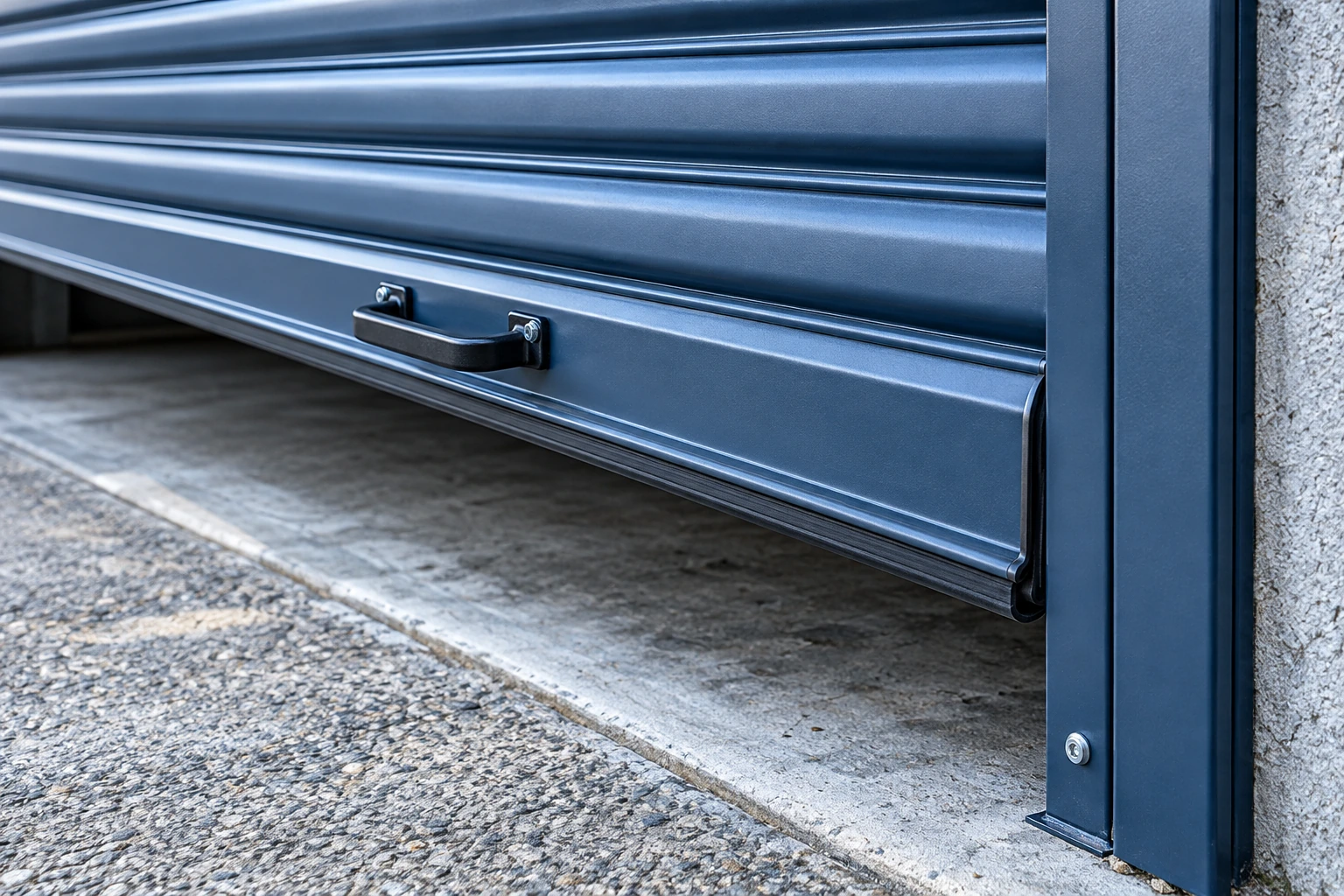
Whether the shutter protects a shop, commercial entrance or industrial unit, start by describing what has changed. Our approach is to assess the assembly, explain the appropriate repair and agree the proposed work. You do not need to know which component has failed before asking for help.
A roller shutter is more than its curtain
The visible curtain is only part of a working roller shutter. Its slats move within guides and roll around an overhead assembly; operating arrangements vary between manual and powered systems. A fault in one area can affect the movement of the rest. Tell us whether the shutter has become heavier, catches at one point or sits unevenly in the opening. A useful assessment considers the installed equipment and the condition of its components together. This helps distinguish a local repair from more extensive work, rather than replacing parts simply because they are easy to see.
Roller shutter stuck open or stuck closed
A shutter stuck open may prevent you securing an entrance, while one stuck closed may restrict access to stock, staff areas or the shop itself. A partly lowered curtain can also create an awkward or unsafe opening. Keep people clear of the affected entrance and do not attempt to pull a damaged curtain back into line. Describe its position when calling and explain whether there is another usable entrance. If the fault followed an impact or unusual noise, mention that too. The current position helps us understand the access problem, but it does not establish the cause without assessment.
Not opening, not closing or stopping halfway
A roller shutter that stops at a similar point on each journey may have a different problem from one that responds intermittently. Uneven travel, catching guides or damage to the curtain can interrupt movement; powered systems may also require assessment of their controls or drive. Avoid repeated attempts to force the shutter beyond its normal travel. Tell us what you observed during ordinary operation, including whether the curtain moved at all and where it stopped. For an electric system, mention which control you used. We can then discuss the inspection required rather than treating every stopped shutter as a motor failure.
Damaged slats, unusual noise and difficult manual operation
Bent or displaced slats may affect how a curtain moves and closes. Scraping, rattling or a change in operating effort can also justify a repair enquiry, even if the shutter still completes its journey. With a manual shutter, extra resistance should not be overcome by applying more force or modifying its operating mechanism. Photograph visible damage only from a safe position and do not remove covers or loaded parts. Compatible slat or guide work may be possible, but the proposed repair depends on the assembly and the extent of damage. An inspection helps establish whether other components have also been affected.
Quotation, access and the repair visit
Provide the postcode, shutter type and current position when you contact us. Explain whether the entrance is used by customers, staff or delivery vehicles, and identify any restrictions on working near it. For managed premises, confirm who can authorise repairs and who will meet the technician. We discuss the proposed work and quotation, arranging a visit where the fault or parts need closer assessment. Ask what is included and what remains dependent on inspection. Once work is agreed, the repair arrangements can be planned around the particular entrance rather than relying on a generic description of the building.
Keeping repair and ongoing care connected
After a repair, it can be useful to discuss servicing requirements for the remaining shutter components. Servicing is not a substitute for reporting an existing fault, and a standard visit should not be assumed to include replacement of damaged parts. Tell us how frequently the shutter operates and whether other entrances show similar changes. For powered-system problems, our electric shutter service covers control and motor enquiries; where the condition makes repair unsuitable, like-for-like replacement can be considered. Manchester and Sale enquiries are welcome during our published 8am–8pm telephone hours, with surrounding-area attendance confirmed by postcode.
Clear answers
Your questions, answered.
Can damaged roller shutter slats be repaired or replaced?
The appropriate work depends on compatibility, the extent of damage and the condition of the whole assembly. A visible bend is a reason for assessment, not proof that only one slat needs attention.
Why is my manual shutter difficult to open?
Resistance can have several causes. Describe when it began and whether the curtain catches or travels unevenly. Avoid forcing it or dismantling the mechanism; an inspection is needed to establish the cause.
Does a noisy shutter need immediate replacement?
Noise alone cannot determine whether replacement is necessary. A change in sound should be reported alongside any change in movement. The repair options depend on the assessed condition of the equipment.
What if the fault is actually electrical?
Tell us the shutter is powered when enquiring. Mechanical resistance and powered-system faults can produce similar symptoms, so the assessment may need to consider both before a repair is agreed.
Are roller shutter doors covered by this repair service?
Yes, enquiries can cover existing roller shutter doors at shops and commercial premises as well as manual roller shutters. Tell us how the opening is used, how it operates and what has changed. Larger industrial or warehouse entrances may also need site-access arrangements discussed.